
Three Cultures One Love
by Lynn Wachtler MSN, RN, FNP-BC, CMCS
Is achieving ‘one love’ really that simple?
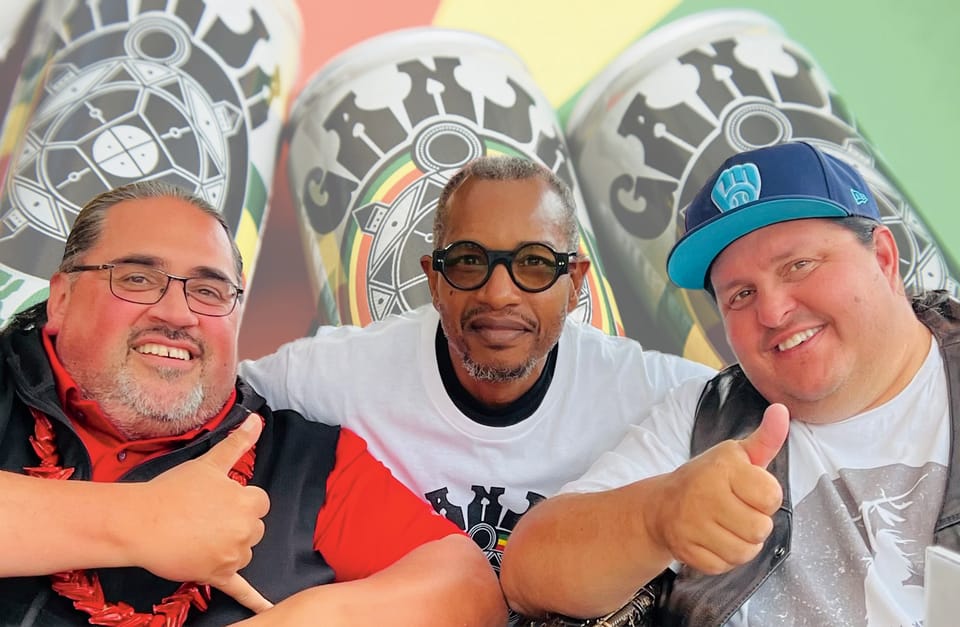
In talking with Leiataua* Dr. Robert Jon Peterson, Kelly Sander, and Richard Nicholson, the three co-owners of RKR Ganja Beverages, a hemp-derived THC drink company, it seems the answer is resounding yes.
Their company’s mission is to uplift the community by promoting strictly positive vibes and a ‘One Love’ philosophy, which symbolizes unity, love, and shared humanity rooted in their collective cultures. This “ganja as a lifestyle” unites product with vision. Identifying as 100 percent Black and Indigenous owned, the Ganja Guys celebrate their Samoan, Anishinaabe, and Jamaican ethnicity and heritage through each can and with every connection they make.
“Centering the ethos of community and cultural pride into our business approach, it’s not only what we do, but it's who we are as people,” Dr. Peterson writes.
They show up seemingly everywhere: Feet in the street, building cultural bridges with their sparkling lime margarita THC beverage called Ganja Skoden. In some Indigenous vernacular, “Skoden” translates to “Let’s go then”—a rallying cry for gathering, expressing energy, and forging relational connection to one another and the Earth. Friends for decades, each has a role and the skill set required to navigate a start-up in a complex and rapidly evolving market.
The Ganja Guys are uplifting and fostering a sense of community by collaborating with local and minority-owned businesses, helping to promote economic opportunity in their community. They actively participate in and sponsor community gatherings and cultural events, such as Juneteenth celebrations, community-based presentations, and local music nights. It is of high importance to them to advocate for healthier communities by supporting Black and Indigenous-owned businesses and entrepreneurship fueled by culture and one love.
The brand relies on symbolism and shared cultural narratives: the logo features a turtle, an Ojibwe symbol representing Turtle Island, the shared Earth and Indigenous creation story, and the four races (Black, Brown, Yellow, and Red). The brand colors refer to the black skin of their people, the blood of their ancestors, and sunlight and the vegetation, drawing direct inspiration from Rastafarian culture.
Their mission of ‘one love’ takes on even greater meaning in a climate where inclusion itself is under threat. This bridge-building and more conscious approach to business, communication, and education, at the corporate level, is now, more than ever, essential for unity and shared love.
As DEI fades, and more of our black and brown friends face the risks many of us can avoid with our silence or skin color, we must examine our own everyday actions and behaviors. They, too, have a ripple effect. Microaggressions are subtle, everyday comments or actions that send negative messages to people because of their race. They are often unintentional but can cause real harm. A goal of healthy communication is to ensure our intentions align with the impact of our words. As we come together in unity, navigation from the heart includes more honesty, more empathy, and just more talking in general.
Recently, I’ve had several intensely raw and painful conversations that gave me significant pause. A nurse I worked with shared that even the most compassionate, well-meaning, Caucasian DEI managers have no idea what it feels like to be black, as they have no real familiarity with the day-to-day experience of racism.
Structural, systemic, and institutional racism can be subtle and so deeply ingrained that we may not even recognize it until it hits close to home. According to a Lending Tree study released this summer, Black home buyers faced a nationwide mortgage denial rate of 19% in 2024, 1.7 times the 11.7% rate of other applicants. Evidence and extensive research are clear that explicit and implicit bias in clinical practice also affects patients. Scientific studies that reflect those inherent biases provide critical information that guides and shapes policies, which in turn can affect lasting change.
While none of us has a crystal ball concerning the future and societal trajectory, it is clear that the concept of ‘ganja as a lifestyle’ —the vision of uplifting and inspiring others through actions, non-exclusion from love, and giving back —is a priority. The RKR brand offers special recognition and honors those who have served in the military with a uniquely designed commemorative coin. RKR Partner Kelly Sander says it’s essential they acknowledge and are thankful for those who have come before them here. Seeking out the good, making the ancestors proud, and keeping the focus and vibes strictly positive isn’t a revolution; it’s really just ‘One Love.’
References:
Linton, A. (2025). Black Homebuyers 1.7 Times More Likely to Be Denied for Mortgages Than All Homebuyers. Lending Tree. https://www.lendingtree.com/home/mortgage/lendingtree-study-black-homebuyers-more-likely-to-be-denied-mortgages-than-other-homebuyers/
Vela, M. B., Erondu, A. I., Smith, N. A., Peek, M. E., Woodruff, J. N., & Chin, M. H. (2022). Eliminating explicit and implicit biases in health care: Evidence and research needs. Annual Review of Public Health, 43(1), 477–501. https://doi.org/10.1146/annurev-publhealth-052620-103528
*Leiataua is a prominent Samoan title signaling authority, leadership, and lineage. It is also used as a surname, following patriarchal lines.